Solar Power for Businesses: A Foundation-Free System That’s Easy to Install Even in Complex Areas with Restrictions
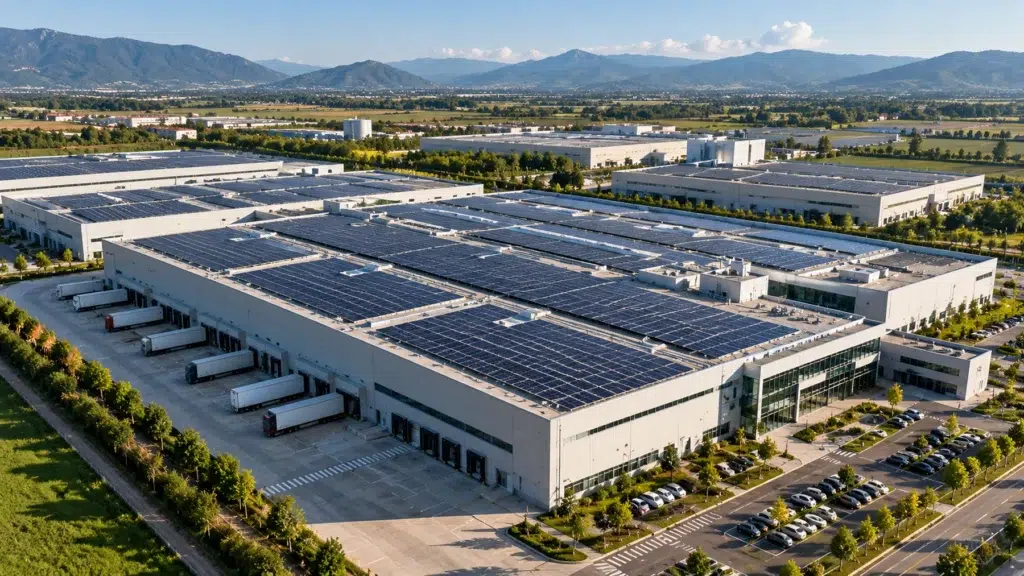
Illustrative cover image.
Already-occupied roofs, land with underground utilities, landscape restrictions, or hard-to-use spaces? SalvaTerra Prime offers businesses a vertical, modular, and self-supporting photovoltaic solution designed to minimize civil engineering work and simplify installation even in the most complex settings.
When the roof is already occupied, where can new photovoltaic panels be installed?
More and more companies are investing in solar energy to reduce energy costs, increase self-generation, and meet their sustainability goals. But not all sites allow for the easy installation of a traditional photovoltaic system.
At many industrial plants, wastewater treatment facilities, logistics centers, and large corporate headquarters, the roofs are already covered with solar panels or other technological infrastructure. In other cases, the roofs are not structurally capable of supporting additional modules.
The most obvious solution would seem to be a ground-mounted photovoltaic system. However, even this option can run into obstacles: underground utility lines, zoning restrictions, maintenance requirements, or the need to preserve the land for future expansions.
The real challenge isn’t always finding new space, but making the most of what’s already available without radically transforming it.
It is precisely in these situations that ground-mounted solar systems without traditional foundations can represent an attractive alternative for businesses.
See also: When the Roof Is No Longer Enough.
Are there ground-mounted photovoltaic systems without concrete foundations?
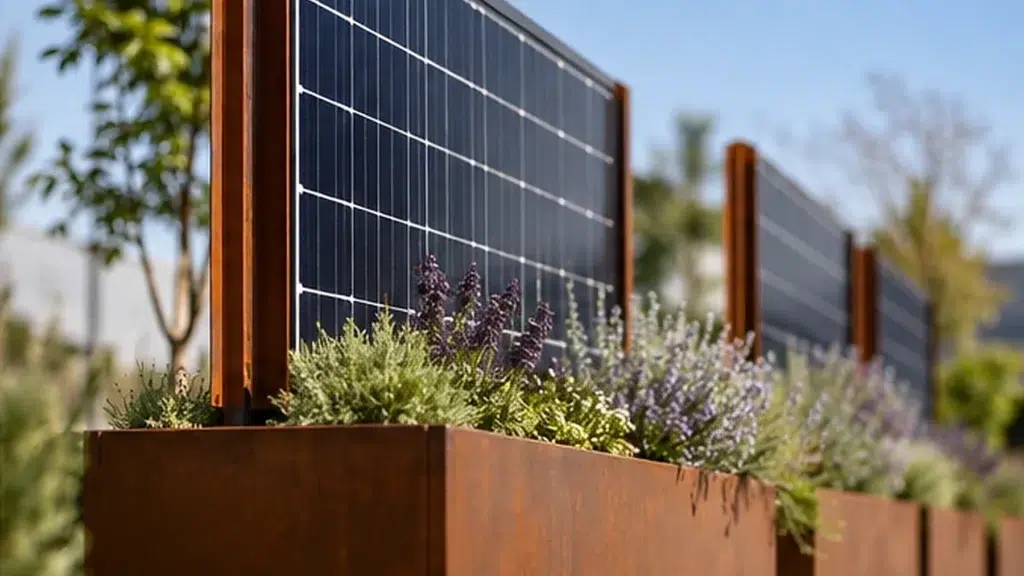
Yes. SalvaTerra Prime, developed by Etway, is a vertical, self-supporting photovoltaic system that, in its standard configuration, does not require concrete footings, driven piles, or permanent ground anchors to support the individual units.
Each element consists of a Corten steel tank, a supporting structure, and two vertically arranged bifacial photovoltaic modules.
Stability is ensured by the structure’s geometry and the weight of the properly filled tank, in accordance with the technical verifications required for the site.
This approach reduces the amount of groundwork and masonry required compared to structures that require traditional foundations.
The result is a solution that is stable during operation yet modular and potentially removable, capable of adapting to the needs of a production site without permanently occupying the ground with the foundations of individual units.
Ground-mounted industrial solar: a solution even for complex areas
Can a photovoltaic system be installed where underground utilities run?
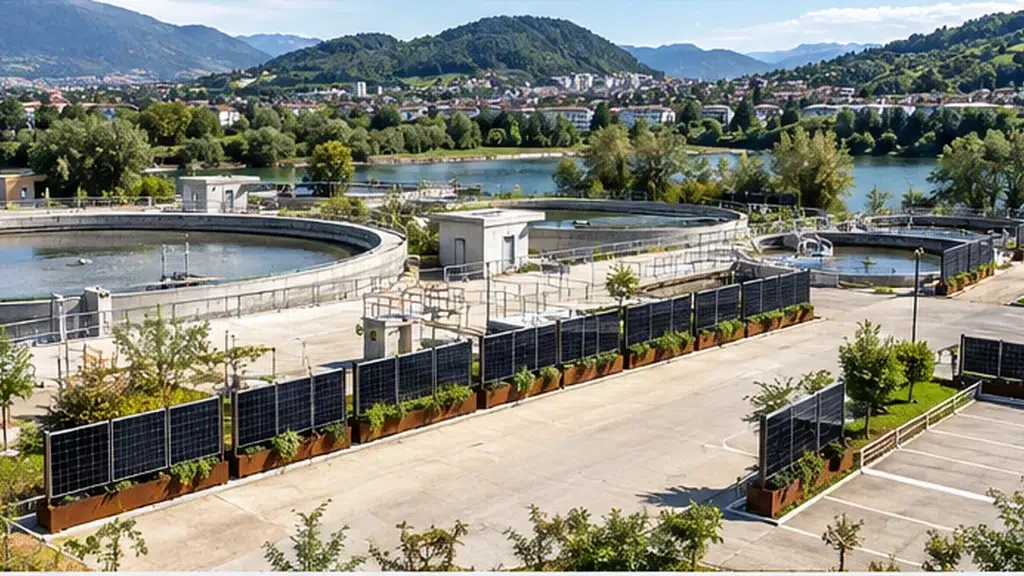
In industrial complexes, the ground is often crisscrossed by water mains, sewer lines, electrical cables, drainage systems, and other underground infrastructure.
Installing photovoltaic systems with deep foundations can interfere with these networks, requiring additional excavation, inspections, and work.
With SalvaTerra Prime, the absence of piles and plinths for individual units helps minimize direct interference with the subsoil.
The system can be designed along the perimeter of the property, green belts, peripheral areas, and internal pathways, with a layout that is compatible with existing infrastructure.
It is still necessary to verify the load-bearing capacity of the installation surface, survey underground utilities, and design any external electrical connections.
In this way, areas that are difficult to use for conventional photovoltaic systems can become new opportunities for energy production.
What permits are required for a photovoltaic system when restrictions apply?
The presence of landscape, environmental, or urban planning restrictions can complicate the installation of a ground-mounted photovoltaic system, especially when the project involves permanent changes to the land.
A self-supporting, removable system like SalvaTerra Prime offers an advantage: it minimizes the need for underground structural work and helps preserve the area’s original characteristics to a greater extent.
The low invasiveness and reversibility of the installation can be favorable factors in the permitting process, helping to facilitate the feasibility study in contexts subject to restrictions.
The absence of foundations, however, does not automatically exempt the project from requiring permits. The procedure depends on the system’s characteristics, power output, location, and specific site constraints.
A modular photovoltaic system that adapts to the company’s growth
Can a photovoltaic system be relocated if the company expands its facility?
A facility’s needs can change. An area available today might be allocated tomorrow to a new warehouse, a production expansion, or a different spatial layout.
This is precisely why modularity is one of the most compelling advantages of SalvaTerra Prime.
Individual units can be disconnected, moved, and relocated to another suitable area after the necessary technical and electrical inspections have been performed.
Unlike structures anchored to the ground with permanent foundations, removing the planters does not normally require the demolition of plinths or the extraction of posts.
The overall restoration will depend on any ancillary works that have been carried out, such as cable ducts and manholes.
This flexibility allows companies to invest in energy production without giving up the option to reorganize their outdoor spaces in the future.
Aesthetics, greenery, and integrated wiring: solar power enhances the landscape
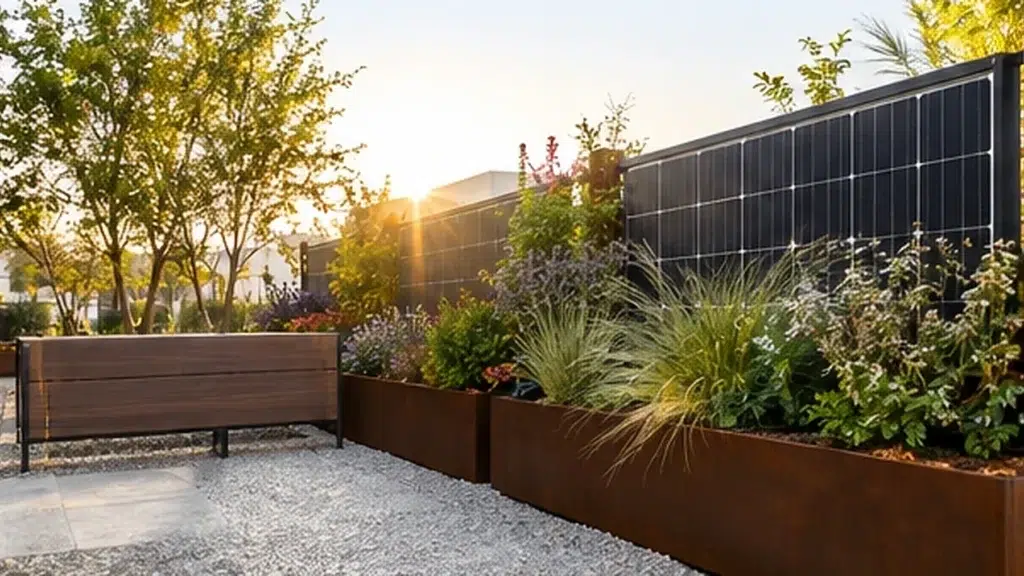
A commercial solar power system does not necessarily have to have the technical and industrial appearance of traditional installations. SalvaTerra Prime combines energy production, design, and landscape integration through a Corten steel structure, whose natural patina—characterized by warm, earthy tones—blends harmoniously with the vegetation and the surrounding landscape. The panels can accommodate ornamental plants and greenery, transforming the system into a decorative element that enhances outdoor spaces. Even the wiring contributes to the visual order: the connections between consecutive units can be housed in channels integrated into the basins, avoiding exposed cables along the sequence. The result is a solution also suitable for corporate headquarters, corporate campuses, and settings where architectural quality is a key requirement.
How much energy does a bifacial vertical photovoltaic system generate?
The bifacial photovoltaic modules used by SalvaTerra Prime can capture solar radiation on both sides, taking advantage of both diffuse radiation and radiation reflected from surrounding surfaces.
The vertical layout can result in a different energy output profile compared to that of a traditional tilted system, with energy contributions distributed differently throughout the day and across the seasons.
The system’s total power output increases with the number of units installed, making it possible to design modular configurations even for businesses with significant energy needs.
Actual production depends on orientation, solar radiation, shading, and site characteristics.
To assess performance and potential economic benefits, it is therefore necessary to develop a specific energy simulation, comparing expected production, company energy consumption, and total investment.
Where can a commercial solar power system be installed without traditional foundations?
SalvaTerra Prime can be considered in various contexts where traditional installations are difficult or incompatible with the site’s requirements.
At wastewater treatment plants and water infrastructure facilities, the presence of underground utilities and technical networks makes the option of avoiding deep foundations for photovoltaic structures particularly appealing.
In industrial facilities and logistics centers, the system can enhance green belts, perimeters, and marginal areas without necessarily compromising future spatial reorganization.
At large corporate headquarters and executive campuses, the integration of solar panels, greenery, and design makes it possible to combine energy production with an aesthetic enhancement of the outdoor environment.
SalvaTerra can also be used as a complementary solution to photovoltaic systems already installed on rooftops, helping to increase the company’s self-generation capacity.
From Available Land to a Concrete Energy Project
Every industrial site has different characteristics. For this reason, the selection of a photovoltaic system must begin with an analysis of the available surfaces, constraints, operational requirements, and electrical connection options.
Etway can conduct a preliminary assessment, taking into account orientation, soil characteristics, underground utilities, any necessary permits, and the configuration of the units.
Based on this, it is possible to estimate the installable capacity, expected energy production, and the key feasibility conditions of the project.
The goal is not to replace traditional photovoltaic systems in every situation, but to make new areas usable and expand opportunities for self-generated energy, even in the most complex installation contexts.
Does your company have available space but face installation constraints?
A roof that is already in use, land crisscrossed by underground utilities, or an area designated for preservation does not necessarily have to prevent a new investment in solar power.
With SalvaTerra Prime, EtWay offers a modular, self-supporting, and non-invasive solution for the mounting structure, capable of combining renewable energy, flexibility, and seamless integration into the landscape.
Request a preliminary assessment of your site.
Based on a site plan and some information about the available areas, we can explore a possible Salvaterra configuration and provide an initial estimate of the installable capacity and the project’s feasibility.