Italy’s Energy Mix in 2026: Where Does the Energy We Actually Use Come From?

When we talk about energy, our thoughts often turn to solar power, electric cars, and new technologies. But to truly understand Italy’s energy transition, we need to look at the big picture: where the energy we use every day comes from, how much of our energy supply still relies on oil and gas, and what role renewables are playing.

Beyond Electricity: The Real Picture of Energy in Italy

When we talk about energy, we often think of solar panels, electric cars, and new technologies. But to truly understand how Italy is changing, we need to look at the big picture: not just how much green electricity we produce, but where all the energy we use every day comes from.

Transportation, heating, businesses, buildings, and cities consume energy in various forms. And this is precisely where an important fact emerges: Italy is making progress in its electricity mix, but in its overall energy mix, it remains heavily dependent on oil and gas.

Pompe di estrazione petrolifera al tramonto, simbolo del peso di petrolio e gas nel mix energetico italiano e della dipendenza dalle fonti fossili.

Energy mix and electricity mix: Why they aren't the same thing

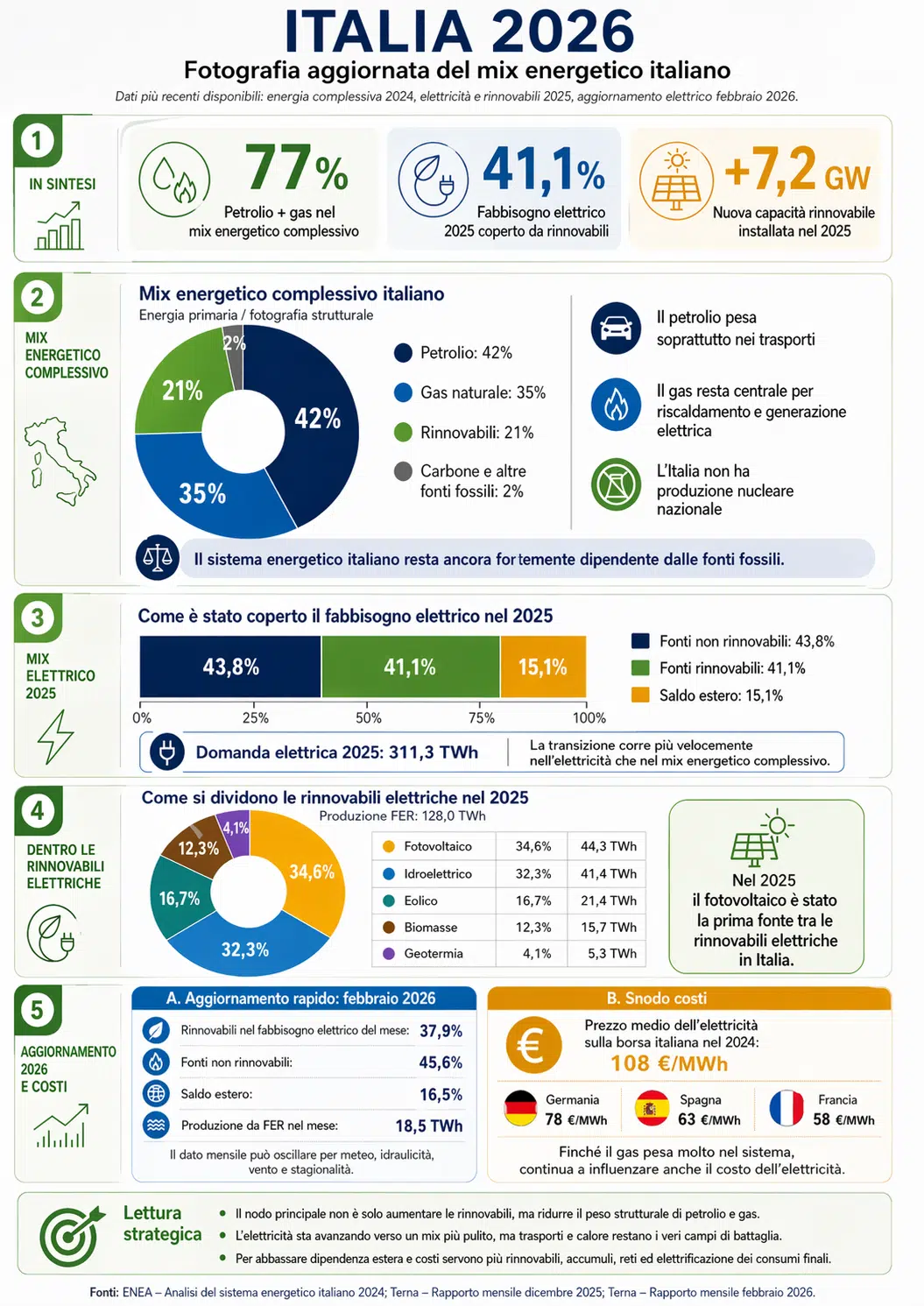
In 2024, Italy consumed approximately 1,696 TWh of primary energy. The breakdown shows that the energy mix remains heavily reliant on fossil fuels:

• oil: 42%
• natural gas: 35%
• renewables: 21%
• coal and other fossil fuels: about 2%

Oil and gas together therefore account for about 77% of Italy’s energy mix.

Oil plays a major role in transportation, while natural gas remains central to residential heating and electricity generation. For this reason, the transition cannot be measured simply by counting the number of new photovoltaic systems installed: the real change lies in reducing the structural role of oil and gas in daily consumption.

Dependence on Foreign Sources and Energy Costs

Italy also remains highly dependent on foreign sources: its overall energy dependence stands at around 72%, while more than 90% of the fossil fuels it consumes are imported.

This makes energy not only an environmental issue, but also an economic, industrial, and strategic one. Any fluctuation in gas and oil prices has a direct impact on the Italian system.

Electricity costs confirm this: in 2024, the average price on the Italian power exchange was 108 €/MWh, higher than in Germany, Spain, and France. The main reason is that natural gas continues to have a significant impact on the pricing system.

Lampadina accesa accanto a monete e giovane pianta, simbolo del legame tra costi dell’energia, risparmio economico e transizione sostenibile.

The 2025 Electricity Mix: The Transition Is Moving Faster

If we look at electricity alone, the picture is more positive. In 2025, Italy’s electricity demand totaled 311.3 TWh and was met as follows:

• 43.8% from non-renewable sources
• 41.1% from renewable sources
• 15.1% from net imports

The electricity system is therefore showing concrete signs of change, even though we have not yet achieved full energy independence or full decarbonization.

Even monthly data, such as those for February 2026, show some variability: renewable energy generation, weather, hydrological conditions, wind, imports, and plant availability continue to influence the system.

Solar power has taken center stage

In 2025, total electricity generation from renewable sources amounted to 128.0 TWh. For the first time, solar power was the leading source of renewable electricity in Italy, ahead of hydropower.

This is an important step: in Italy, solar power is no longer just a promise, but a fundamental component of the country’s electricity production.

The key strategic issue, however, remains clear: simply increasing the share of renewables is not enough. We also need energy storage, stronger grids, faster procedures, and greater electrification of end-use consumption in transportation, heating, and parts of the industrial sector.

Here's an interesting fact: How many SalvaTerra units would it take to power Italy?

Let’s try a simple exercise—one that’s deliberately provocative.

Assuming a SalvaTerra system of approximately 0.88 kWp and an estimated annual output of about 880 kWh, to theoretically cover Italy’s entire electricity demand in 2025—which amounts to 311.3 TWh—the following would be required:

311,324,000,000 kWh / 880 kWh = approximately 354 million SalvaTerra

To put it more lightly:

How many SalvaTerra units would it take to “save the planet”?

About six for every Italian resident.

This is obviously a provocation, not a real energy plan. But it serves to highlight a concrete truth: the transition cannot be achieved with a single technology or a single product. It is built on a variety of widespread, integrated, and smart solutions.

And this is where SalvaTerra takes on an interesting significance: it does not claim to replace the national energy system, but helps bring energy closer to people, buildings, urban spaces, and local communities.

SalvaTerra integra fotovoltaico verticale e verde ornamentale negli spazi urbani.

Because this issue also concerns the future of cities

Today, the value of energy lies not only in producing kilowatt-hours.

It’s also about how we produce them, where we produce them, and how we integrate them into the urban landscape.

The energy transition in the coming years will not only involve large-scale facilities located far from where people live their daily lives. It will increasingly involve distributed solutions that are visible, attractive, and useful—solutions capable of combining energy functionality, quality of space, and a culture of sustainability.

That is why the issue of Italy’s energy mix is not an abstract one. It is an issue that concerns cities, businesses, the landscape, energy independence, and quality of life.

The picture for 2026 is clear:

• Italy remains heavily dependent on oil and gas in its overall energy mix;
• The electricity system is improving, and renewables now account for a significant share;
• Solar power has become the leading source among renewable electricity sources;
• The cost of energy remains a strategic issue because natural gas continues to influence the system.

The real question isn’t just how much energy we’ll produce in the coming years.

The real question is what kind of country we want to build through energy.

And perhaps, rather than wondering how many SalvaTerra units it would take to power all of Italy, it’s worth asking this:

How many smart, widespread, and integrated solutions are needed to truly change the way we use energy?