📍 Etway S.R.L. | VIA KUFSTEIN 1, 38121 TRENTO (ITALY) | 📞 +39 0461 99 36 43

the solution to the energy problem
the solution to the energy problem
Solar-Fence Photovoltaic Fence
The Context
ENERGY – The global energy landscape faces major challenges in the coming years as it must balance two fundamental needs:
- The increase in energy consumption, which is attributable to population growth, global economic development, and the need to ensure universal access to energy
- The urgency of combating climate change by immediately mobilizing all available resources and accelerating the transition to a more sustainable energy mix.
THE COMPANY – Growing amid change —that is the challenge companies must face in light of current market dynamics. Countering the price shock and becoming sustainable— that is the path that can lead small and medium-sized enterprises toward the energy transition and turn a problem into an opportunity for growth. Companies that can react quickly to these dynamics will become more competitive and continue on their path to success.
THE SOLUTION – The “Solar Fence” photovoltaic fence provides an effective solution to energy challenges and soil conservation. With its vertical structure, it offers an innovative and functional solution.
The “Solar Fence” photovoltaic fence is the solution to the energy problem and to protecting land. It generates electricity from renewable energy sources by extending upward.
The Product
Solar Fence is a vertical photovoltaic system consisting of modular elements integrated into a sleek, sturdy, and durable structure. The geometry is designed to maximize energy yield, with a 33° tilt and a 623 mm spacing between modules to minimize shading.
The module housing consists of a cold-rolled, galvanized steel profile of grade S235J0, coated with polyester powder paint in a RAL color selected by the client. This profile features hollow chambers that ensure proper ventilation around the module and allow for the installation of the junction box and electrical cables .
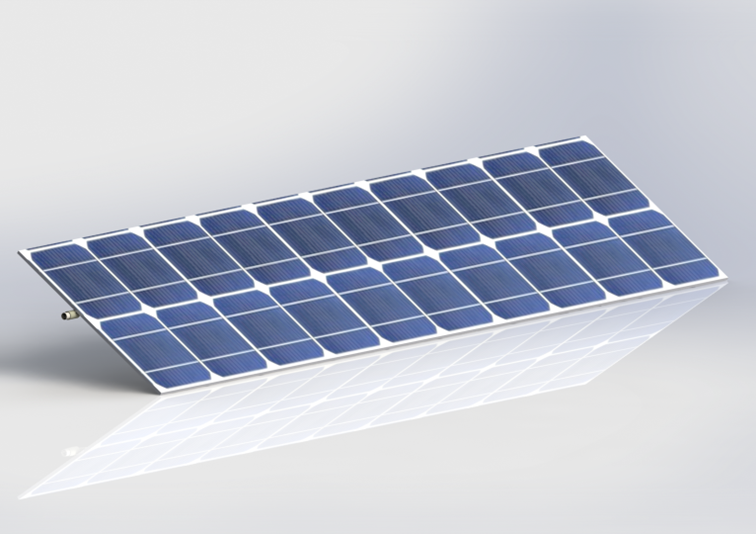
Modules with a center-to-center distance of 3.4 m or 4 m
Reinforced concrete foundation
Cold-Rolled Profiles and Brackets
The photovoltaic modules were specifically designed for integration into the fence; they are custom-made, frameless modules with monocrystalline silicon cells that can be connected in series or in parallel, depending on the specific design requirements. All components of the fence, including the photovoltaic modules, are available in two versions with a center-to-center distance of 3.4 m or 4 m. In both cases, the actual structure consists of steel posts to which cold-rolled shaped profiles are attached; these , in turn , are anchored in a reinforced concrete foundation that can either be cast on site or consist of precast elements. If you wish to generate more energy from the fence without taking up additional walkable space, the solution can be supplemented with a photovoltaic top-mounted structure that is attached to the top of the post and consists of a row of standard photovoltaic modules aligned with one another.
TECHNICAL DETAILS
The Solar Fence consists of:
- Cold-rolled profile made of galvanized steel sheet with a nominal thickness of 0.7 to 0.8 mm, which was coated with polyester powder after all processing steps and cured in an oven; the profile features a corrugated surface suitable for accommodating custom-made photovoltaic modules as well as the associated electrical cables and junction boxes;
- Triangular brackets made of galvanized steel with corresponding eyelets for attaching the profiled module support rail, which are mounted on the post;
- Posts made of galvanized IPE steel, the dimensions of which depend on the height of the fence;
- Custom-made photovoltaic modules with a power output of 110 to 140 Wp each, made of monocrystalline silicon and equipped with electrical cables for series or parallel connection;
- Photovoltaic mounting system consisting of inclined IPE steel posts welded to the vertical post, support beams, and standard photovoltaic modules (of your choice).
The photovoltaic modules are inserted into the trapezoidal profile, which in turn is attached to the brackets anchored to the steel posts. This creates a series of module rows, which are then connected to one another using the cables provided. The post is firmly anchored to the reinforced concrete foundation, which was either poured on site or consists of modular precast elements.This creates a solid vertical photovoltaic system.
The “Solar Fence” photovoltaic fence is available in heights ranging from 2 to 6 meters. It has a modular design, making it easy to install and versatile, as it can be quickly dismantled and moved from one location to another, with the same components reused.
ENERGY AND FINANCIAL SIMULATION
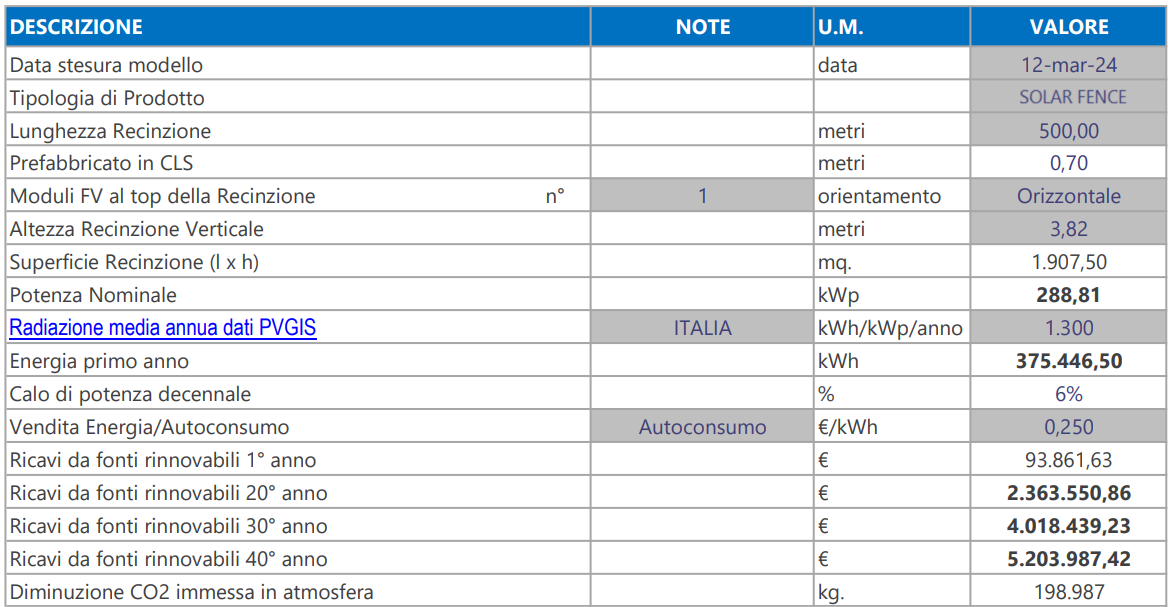
Below is a brief simulation of a fence that is 500 meters long and 3.82 meters high , with a standard photovoltaic module mounted on its top, bringing the total height to 4.41 meters. The simulation assumes 1,250 hours of sunshine per year and a power degradation of the photovoltaic modules of 0.6% per year; it also uses an average selling price for the generated energy of 0.30 euros/kWh. The project simulation shows that a system of this size has a peak output of 288 kWp, an annual generation of 360,000 kWh, and annual savings of 108,000 euros . The model also incorporated an estimated inflation rate of 3% per year, resulting in revenues of 2.7 million after 20 years and 4.6 million in the 30th year.
The “Solar Fence” photovoltaic fence is well-suited for use on farms due to its characteristics. The Ministry of the Environment and Energy Security has submitted a decree to the European Commission to promote the installation of innovative agrivoltaic systems using PNRR funds. Funding is thus availablefor the agrivoltaic sector to implement innovative integrated solutions in which the modules are mounted above the ground in such a way that they do not interfere with ongoing agricultural operations; SolarFence fits seamlessly into funding programs of this kind. The measure provides for the following:
- Non-repayable grant of up to 40% of eligible costs
- Feed-in tariff for the portion of electricity generated and fed into the grid.
Ifyou owna farm and are interested in installing a solar pergola or would like more information, please fill out the form below. Our technicians will then contact you to conduct a free feasibility study.
The Benefits of a Photovoltaic Fence
- High economic return
- Long service life of the investment >25 years
- Reduction of Environmental Impact
- Verified Energy Generation
- Minimal space requirement in the transverse direction
- Choosing a Color Scheme
- Modular Fence
- Movable Fence
Request a Free Feasibility Study
Photovoltaic Fence
Our Partners