📍 Etway S.R.L. | VIA KUFSTEIN 1, 38121 TRENTO (ITALY) | 📞 +39 0461 99 36 43


The Hidden Cost of Solar Power: It’s Not Just About Investment and Energy Production
The true cost becomes apparent over the years
When evaluating a photovoltaic system, the focus is almost always on two main factors: the initial cost and the expected output. This is an understandable approach, because these figures are readily available, easy to compare, and often decisive in the final decision. However, there is a third variable—less obvious but just as crucial in the long run—the cost of maintaining that output over time.
This point becomes clear when we consider an often-overlooked issue: the cleaning of photovoltaic modules.
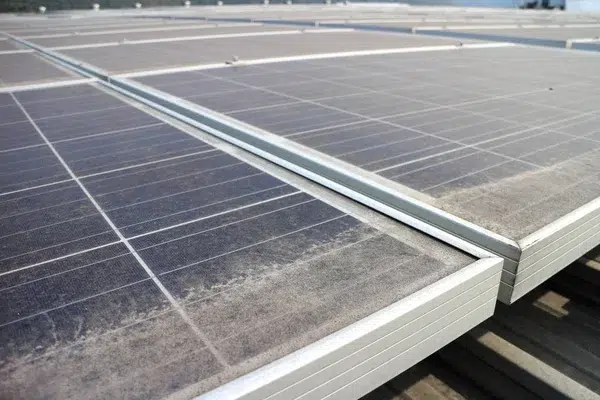
Cleaning Solar Panels: An Underestimated Issue
Over time, dust, smog, pollen, organic debris, and atmospheric agents accumulate on the surface of the panels. Even in seemingly “clean” environments, this phenomenon is inevitable. The result is a gradual reduction in efficiency: the less light that reaches the cells, the less energy is produced. In some cases, the loss can reach significant percentages, especially in urban or industrial areas.
At this point, an operational decision comes into play: to clean or not to clean.
Cleaning the modules involves a cost. Whether it involves manual work, automated systems, or outsourced services, it is still a recurring expense. Not only that: in some systems—such as those on hard-to-reach rooftops or installations integrated into complex urban environments—cleaning can become logistically complicated and therefore even more expensive.
For an average 20-kW system, professional cleaning generally costs between 400 and 600 euros per service, depending on the roof’s accessibility and the condition of the system.
On average, cleaning is recommended 1–2 times a year, although in urban areas or areas particularly prone to dirt, it may be advisable to clean more frequently.
On the other hand, failing to take action means accepting a loss in performance. And over time, this loss translates into lower revenue or fewer energy savings. In other words, even “doing nothing” has a cost, albeit a less visible one.
There's always a cost, even when you can't see it
This leads to a fundamental point: costs exist in both scenarios. The difference is that one is often explicit (maintenance), while the other is implicit (loss of production).
Many investments are evaluated solely on the basis of the initial price and theoretical performance. But in the case of solar power, ignoring operating costs means having an incomplete picture. Even small efficiency losses, if they persist over time, can add up to significant amounts.

Total Cost of Ownership: The True Metric to Consider
This is precisely where the concept of total cost of ownership (TCO) comes into play. This principle encourages us to look beyond the purchase price and consider all the costs associated with an asset throughout its entire life cycle: installation, operation, maintenance, long-term efficiency, and, finally, eventual disposal.
In the photovoltaic sector, TCO is particularly important. A system is designed to operate for 20–30 years, and even small inefficiencies, if sustained over time, can have a significant economic impact. A 5–10% loss in annual production, accumulated over decades, can easily exceed the initial cost of regular maintenance.
Designing for Durability: The Importance of Initial Choices
Furthermore, not all systems are the same. Some design solutions already take these aspects into account: angles that promote self-cleaning with rain, materials less prone to dirt buildup, and vertical or semi-vertical configurations that drastically reduce the need for maintenance. In these cases, the operating costs associated with cleaning can be significantly lower than those of traditional systems.
This means that the evaluation of a plant should not stop at the question “How much does it produce?”, but should evolve into a broader consideration: “How much does it cost me to maintain this level of production over time?”
It’s a subtle but significant difference. Because it shifts the focus from a static view to a dynamic one, from an upfront cost to an overall investment.

Ultimately, choosing a solar power system is not just an immediate technical or financial decision, but a long-term strategic choice. Taking into account hidden costs—such as maintenance and efficiency losses—provides a more realistic and comprehensive view of the investment’s value.
And over time, this awareness makes all the difference.